Cover Planning
August 2026
Tata AIA Term Life Insurance: Cover, Types, Premium, Inclusions & Benefits
India's trusted insurer with high claim settlement ratio & wide range of coverage.
Reviewed by InsuranceBolo Editorial Team | Last updated: 1 August 2026
Direct Answer: What term life insurance does
Term life insurance replaces the financial value of your future income if you die while the policy is active. You choose a cover amount, policy term and payout structure; the insurer prices the risk after reviewing age, health, occupation, income and lifestyle. A pure term plan normally pays no maturity amount, which is why it can provide a large death benefit at a relatively low cost. In 2026, qualifying individual life insurance premiums are also GST-exempt, but tax deduction under Section 80C generally matters only if you use the old tax regime.
₹1 crore looks enormous on a quotation screen. It feels much smaller when the same money must close a home loan, replace twenty years of income, educate two children and support a surviving parent. That mismatch—not the premium—is where a term-insurance decision should begin.
The difficult questions arrive later. Should the cover end at 60 or 75? Is a medical test a warning sign or useful evidence? Does a 99% claim ratio prove that your own claim will be paid? Is return of premium genuinely valuable, or simply comforting? This guide answers those questions from the family’s side of the contract, then traces the policy all the way from proposal form to nominee payout.
This is not a “top 10 plans” page and it does not award a winner merely because one quotation is cheaper. Every recommendation is tested against the same five questions: Is the cover enough? Can the premium survive a bad year? Were all disclosures captured correctly? Can the nominee understand the payout? Does the feature solve a real financial gap?
Term life insurance is a benefit-based life insurance contract. The insurer does not reimburse an expense bill. It pays the agreed death benefit when the insured event occurs during the policy term and the contract is valid. The amount payable is governed by the policy schedule, benefit option, rider selection, premium status and any applicable exclusion. That distinction matters because the nominee does not have to prove that the family actually “lost” ₹1 crore. The insurer pays the contractual amount, not an estimate of financial damage made after death.
The product contains four separate roles that buyers often mix up. The proposer applies and pays. The life assured is the person whose death activates the benefit. The policyholder owns contractual rights such as nomination and servicing. The nominee receives claim money in the manner allowed by law. In the simplest case one person is proposer, policyholder and life assured, while a spouse is nominee. In spouse or business arrangements these roles may differ, and every difference changes documentation, insurable interest and taxation.
A pure term plan has no investment account and normally no survival payout. This is deliberate. The premium largely buys mortality protection and operating services, allowing the sum assured to be much larger than under a savings-oriented plan for the same outflow. Return-of-premium plans are still term insurance, but part of the higher premium funds a survival refund. They must be evaluated as a separate economic proposition rather than marketed as “free insurance.”
The proposal form is not a casual questionnaire. It is the factual foundation on which the insurer accepts risk and prices the contract. Answers supplied by an agent, tele-caller or comparison portal remain attributable to the proposer once signed or digitally confirmed. Read the completed proposal before final submission. Correct a wrong answer in writing immediately; screenshots and email acknowledgements are valuable evidence.
Rahul ko agent ne bola, “Sir occasional smoking mention karne ki zarurat nahi.” Rahul ne OTP dekar proposal approve kar diya. Contract ke record mein answer Rahul ka maana jayega. Asli rule simple hai: jo bhi health, tobacco, alcohol, occupation ya old-policy information form mein hai, uski final zimmedari proposer ki hai. Submit karne se pehle PDF mangao, line-by-line check karo aur correction email save rakho.
Death creates two simultaneous changes in a dependent household. Income may stop permanently, while several expenses continue or rise. Rent or home-loan EMI, food, school fees, medical support for parents, domestic help, transport and routine bills do not disappear. The surviving family may also need a large emergency reserve, professional advice and time away from work. Term insurance transfers part of this financial shock to an insurer for a known premium.
Term cover is the temporary capital that connects today’s savings to tomorrow’s obligations.
The correct question is not “Am I likely to die early?” Low probability is exactly why insurance pooling works. The correct test is: Would my death create a financial deficit that my current assets cannot absorb? If the answer is yes, term cover is relevant. A 29-year-old with a spouse, a ₹55 lakh home loan and only ₹8 lakh of liquid investments may have a larger protection gap than a 45-year-old with no debt and a financially independent family.
Term insurance is not a substitute for an emergency fund, health insurance, disability protection, retirement investing or a will. Those tools solve different risks. Life cover provides capital after death; it cannot pay a hospital bill while you are alive unless a separate rider event is covered, and it cannot replace long-term retirement savings if you survive.
India's trusted insurer with high claim settlement ratio & wide range of coverage.

Claim considerations, premium calculations, coverage and FAQs
A universal “everyone needs ₹1 crore” message is commercially convenient and financially wrong. A person may not need a large personal term plan when no one depends on the person’s income, liabilities are negligible, funeral and estate costs are covered, and financial assets are sufficient for all intended beneficiaries. The calculation can also fall over time as debt reduces and children become independent.
However, “no salary” does not mean “no economic value.” A homemaker may perform childcare, elder care, cooking and household management that would cost money to replace. A non-earning spouse can therefore create a genuine capital requirement. Similarly, a retired parent may still need cover for a dependent spouse, an outstanding home loan or estate equalisation among heirs.
The popular income-multiple rule is a screening tool, not a financial plan. Fifteen times annual income may be excessive for one person and dangerously low for another. A stronger calculation has three layers: immediate obligations, future household capital and a deduction for usable assets.
Items to include: Home loan, personal loan, business guarantee, funeral and transition expenses
Calculation approach: Use current outstanding amount plus a contingency margin
Items to include: Household expenses required for surviving dependants
Calculation approach: Annual requirement × dependency years, adjusted for inflation and investment return
Items to include: Education, marriage support, parent care, relocation, spouse retirement
Calculation approach: Estimate future cost, then discount to today’s value
Items to include: Liquid investments, existing individual cover, employer benefit likely to be available
Calculation approach: Subtract only assets the family can actually use without destroying other goals
A practical Human Life Value model can be written as:
Do not subtract the family home if the survivors must continue living there. Do not count retirement money twice. Employer group cover should receive a conservative value because it can disappear with a job change.
Amit earns ₹15 lakh a year. His family needs ₹7.2 lakh annually after removing his personal expenses. He wants to fund 22 years of dependency, has a ₹48 lakh home loan, wants ₹35 lakh in today’s value for two children’s education, holds ₹18 lakh of usable investments and has ₹25 lakh employer cover. A rough non-discounted estimate is ₹1.584 crore for household expenses, plus ₹83 lakh for debt and education, minus ₹43 lakh of assets and employer cover, producing approximately ₹1.97 crore. Inflation and investment-return assumptions can push the answer up or down, so a ₹2 crore to ₹2.5 crore range may be more defensible than blindly buying ₹1 crore.
Pooja ki salary ₹10 lakh hai, lekin uske parents financially independent hain, koi loan nahi aur investments ₹70 lakh hain. Rahul bhi ₹10 lakh kamata hai, par ₹60 lakh home loan, two children aur dependent mother hai. Dono ko same ₹2 crore cover dena logical nahi. Salary same hai; financial deficit bilkul alag hai.
A death benefit is a fixed rupee amount unless the policy has an increasing-cover feature. Household costs are not fixed. At 6% annual inflation, an expense of ₹50,000 per month becomes roughly ₹89,500 after ten years and around ₹1.60 lakh after twenty years. A ₹1 crore lump sum received two decades from now will not purchase what ₹1 crore purchases today.
Inflation can be addressed in four ways: buy a larger level cover now, select an increasing-cover option, add another policy as income and responsibilities rise, or create a disciplined investment portfolio alongside insurance. Increasing-cover features are useful only after reading the mechanics. Some increase for a limited number of years; some raise premium; some cap total growth; and some stop after a claim-triggering rider event.
The useful term is the period during which your death would create an unacceptable deficit. It often ends when earned income is no longer needed, loans are repaid, children are independent and retirement assets can support the surviving spouse. Buying to age 100 can sound comprehensive, but protection beyond the dependency period may deliver poor value if premium is significantly higher.
Start with the latest of four dates: expected retirement, loan closure, youngest child’s financial independence and end of parent or spouse dependency. Add a modest buffer for uncertainty. A 31-year-old planning to retire at 60 with a 25-year home loan and a newborn child might select cover to 65 rather than 85. A self-employed person expecting to work until 70 may choose differently.
Priya age 30 hai, retirement target 58, home loan 23 years ka hai aur daughter 2 years ki hai. Sirf “maximum term” select karna smart choice nahi. Uska core dependency period around age 60–65 tak hai. Age 85 cover tabhi meaningful hoga jab estate need ya dependent spouse ka clear reason ho. Extra years ka premium pehle compare karo.
Premium-paying term determines cash-flow risk. Regular pay usually requires payment throughout the policy term. Limited pay completes premium in a shorter period while cover continues. Single pay funds the contract upfront. The choice does not change the need for accurate disclosure, and a shorter payment period is not automatically cheaper on a present-value basis.
Limited pay is useful when future income is uncertain but current liquidity is strong, or when a buyer wants premiums to end before retirement. Regular pay may be better for young buyers who need a high cover but cannot divert a large annual amount. Compare internal rate of return only if there is a survival benefit; for pure term, compare the present value of premiums and the value of retained liquidity.
| Type | How it works | Best suited to | Main caution |
|---|---|---|---|
| Level term | Sum assured remains fixed | Most buyers seeking simple protection | Inflation reduces real value |
| Increasing term | Cover rises under a defined schedule | Young families with growing needs | Increase period, cap and premium rules vary |
| Decreasing term | Cover falls over time | Matching a reducing loan in specialised cases | Family income need may not fall with loan |
| Return of premium | Specified premiums refunded on survival | Buyers who value a guaranteed refund | Much higher premium and weak real return |
| Joint-life term | Two lives covered under one contract structure | Some couples and loan-linked needs | Benefit triggers and continuation rules can be complex |
| Convertible term | May allow conversion under product conditions | Buyers seeking future flexibility | Rare and tightly defined in India |
| POS term | Simplified non-medical product within regulatory parameters | Customers needing accessible basic cover | Can have lower limits or a waiting period |
| Group term | Master policy covers employees or members | Employer or association benefits | Cover is linked to membership and not fully controlled by you |
Level term remains the clean benchmark. Increasing term should be assessed against buying additional cover later. Return of premium should be compared against a pure-term-plus-investment strategy. Joint-life cover must be tested for what happens after the first death: does cover continue for the survivor, reduce, terminate or require new underwriting? Product names rarely answer these questions.
The emotional objection to pure term is simple: “What do I get if I survive?” The financial answer is that you received risk cover every day the policy remained active. A home-insurance customer does not expect the premium back because the house did not burn. Return-of-premium plans address the emotional preference but charge for the refund.
Assume a pure term premium is ₹15,000 a year and an ROP version is ₹42,000. The extra outflow is ₹27,000 annually. If that difference is invested for 30 years, its future value can be substantial even after allowing for moderate returns. The ROP maturity amount may refund only specified base premiums, not every tax, rider charge or additional loading. Since individual life insurance became GST-exempt in 2025, the comparison is cleaner than before, but the opportunity cost remains.
Neha ko ₹27,000 extra har saal dena hai sirf premium refund ke liye. Agar woh discipline se difference invest kar sakti hai, pure term zyada flexible ho sakta hai. Agar woh invest nahi karegi aur guaranteed refund usko policy continue rakhne mein help karta hai, ROP behavioural value de sakta hai. Decision return ke naam par nahi, actual cash-flow behaviour par lo.
A large lump sum gives flexibility but places investment and spending responsibility on the nominee during grief. Monthly income creates structure but can be eroded by inflation and may be less flexible for immediate debt. A combination can clear liabilities and provide regular household cash flow. The right option depends on the nominee’s financial capability, existing debt and family support system.
Do not select income payout simply because the illustrated total appears larger. A stream paid over decades has a lower present value than the same arithmetic total today. Compare timing, escalation, guarantee period and what happens if the nominee dies during the income period.
A rider is an additional contractual benefit attached to the base policy for extra premium or through an inbuilt feature. Riders can improve protection, but they can also create overlapping cover and exclusions. A rider’s definition—not its name—determines value.
| Rider | Trigger | Potential value | Critical checks |
|---|---|---|---|
| Accidental death benefit | Death meeting policy’s accident definition | Extra payout for accidental death | Exclusions, time link between accident and death, occupation restrictions |
| Critical illness | First diagnosis satisfying exact disease definition and severity | Lump sum while alive | Covered illnesses, survival period, waiting period, benefit acceleration vs addition |
| Waiver of premium | Specified disability or critical illness | Keeps base cover active without future premium | Whose event triggers waiver and which premiums are waived |
| Accidental total and permanent disability | Permanent disability as precisely defined | Income support or premium waiver | Occupation test, permanence period, exclusions |
| Terminal illness | Diagnosis meeting life-expectancy definition | Early payment of part or all death benefit | It may reduce final death benefit |
Car insurance mein har add-on useful nahi hota; usage aur risk dekhte ho. Term rider bhi waise hi hai. Rahul ke employer ne strong disability cover diya hai, lekin personal critical-illness fund weak hai. Uske liye CI rider relevant ho sakta hai. Pooja ke paas standalone critical-illness policy already hai; same benefit duplicate karna zaruri nahi. Rider tab lo jab exact gap fill ho, sirf premium calculator ka checkbox dekhkar nahi.
A critical-illness rider is not a health-insurance replacement. It pays a fixed benefit after satisfying a definition; it does not reimburse every hospital expense. Accidental death riders are not required for the base term sum assured to cover an accident, because standard term cover generally pays the base benefit for covered accidental death. The rider adds an extra amount.
The base policy covers death, not every financial hardship. Job loss, temporary disability, hospitalisation and retirement are not automatically covered. Read the benefit schedule to determine whether a rider is additional to or accelerated from the base sum assured.
Exclusions are not a hidden list of every possible cause of death. Fully underwritten term policies commonly have a comparatively narrow base exclusion structure, with the suicide clause being central. Rider benefits carry broader exclusions. Simplified products can have waiting periods. A lapsed policy is not an “exclusion”; it is a contract that may no longer be in force.
Never rely on a generic website list to understand exclusions. Download the policy wording, not merely the brochure. Search for “exclusion,” “suicide,” “waiting period,” “definitions,” “claim procedure” and “revival.” Product-specific language controls the claim.
Underwriting matches premium and conditions to risk. A medical test may include height, weight, blood pressure, blood and urine tests, ECG, treadmill test, liver or kidney markers and specialist reports depending on age, cover and history. The insurer can also obtain information through tele-medical interviews and authorised databases.
Non-medical issuance does not mean health is irrelevant. It means the insurer accepted the proposal using declarations and available evidence without arranging a physical test. The duty to disclose remains. A buyer with known diabetes who receives a non-medical offer must still state diabetes.
Sunita ka BP medicine se controlled tha, isliye usne socha “problem toh hai hi nahi.” Proposal mein hypertension ka answer No kar diya. Controlled condition bhi medical history hai. Sahi answer Yes hota, medicine name aur reports ke saath. Insurer load kare ya standard accept kare, woh underwriting ka decision hai; fact chhupana buyer ka risk ban jata hai.
Insurers ask more than “Do you smoke?” They may ask whether you have used cigarettes, bidis, cigars, pipes, chewing tobacco, gutkha, nicotine replacement or vaping products within a specified period. The required look-back varies. Answer the exact question and disclose frequency. “Social smoking” is not an insurance category unless the form defines it.
Alcohol assessment considers quantity, frequency, liver markers, treatment history and risky behaviour. Occupations such as commercial aviation, mining, armed services, offshore work, high-voltage operations and certain security roles may trigger additional questions. Recreational aviation, mountaineering, racing and diving can affect underwriting or rider coverage.
“Main daily smoker nahi hoon” aur “main tobacco use nahi karta” same statement nahi. Form agar last 12 months ya 5 years ka usage poochta hai, weekend cigarette bhi answer ko Yes bana sakti hai. Premium bachane ke liye wrong category lena family ke crore-rupee claim ko risk mein daalna hai.
An agent does not guarantee claim payment, and buying online does not make a claim automatic. Claims are decided under the contract and law. The strongest channel is the one where the buyer understands the product, controls the proposal and maintains evidence.
Income proof establishes financial eligibility, not merely the ability to pay premium. Insurers limit cover to a defensible relationship with income and human-life value. A high bank balance does not always substitute for stable income. Self-employed applicants should maintain filed returns and clean banking records well before applying.
Amit ka business cash-heavy tha aur ITR mein income low dikh rahi thi. Usne ₹5 crore cover apply kiya, lekin financial underwriting ne lower limit offer ki. Insurance company Instagram turnover ya verbal income accept nahi karti. Filed ITR, audited statements, GST/business records aur bank trail jitna clear hoga, cover justification utna strong hoga.
Term insurance brochures are sales summaries. The policy schedule and wording are the contract. Verify the name and date of birth of life assured, proposer relationship, sum assured, policy term, premium-paying term, instalment amount, due date, payout option, nominee, riders and risk-commencement date.
For return-of-premium or linked features, distinguish guaranteed from non-guaranteed values. For limited pay, check whether future premium waiver and rider terms continue after the payment term. For income benefits, review the payment frequency, duration and treatment after nominee death.
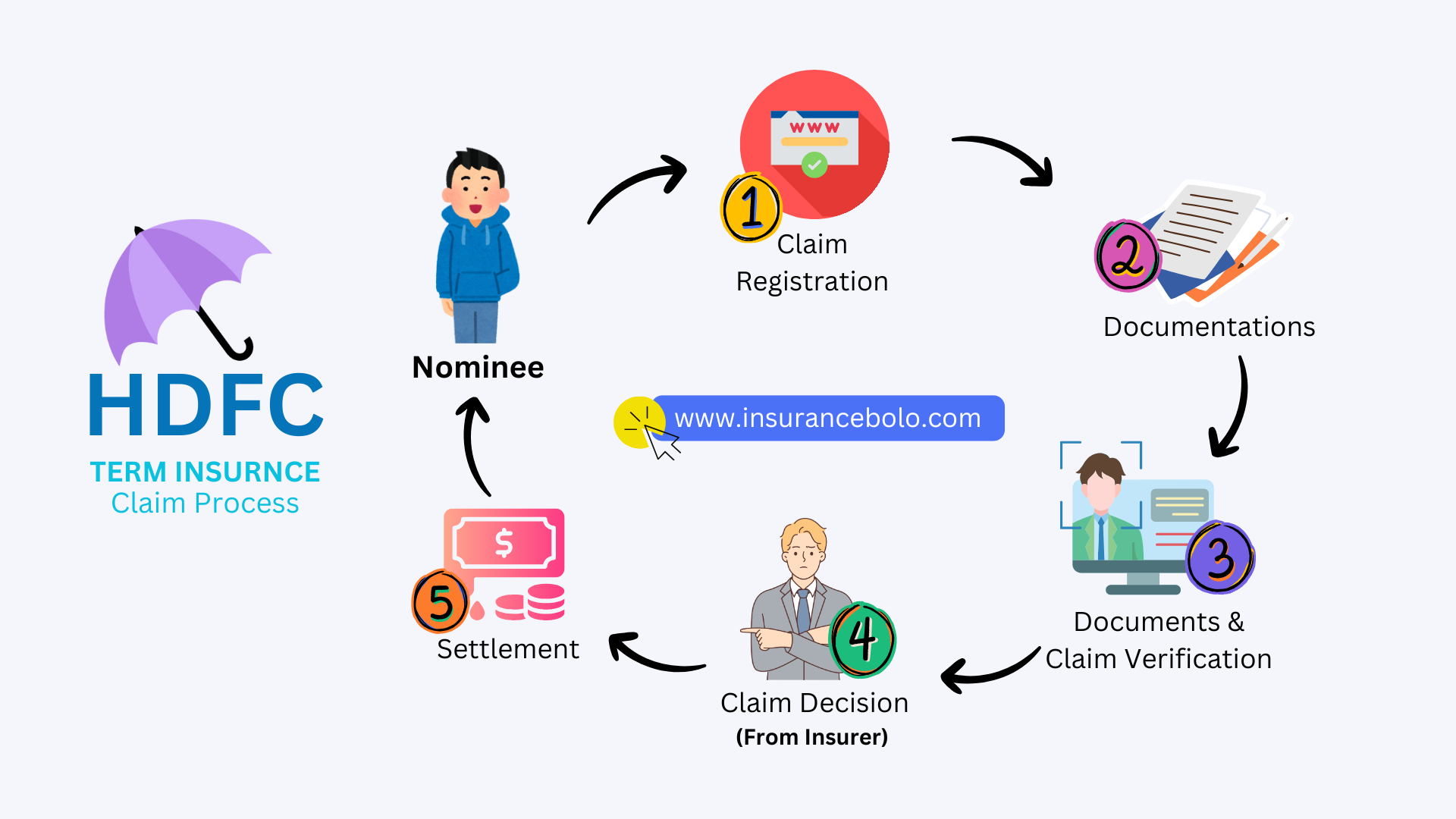
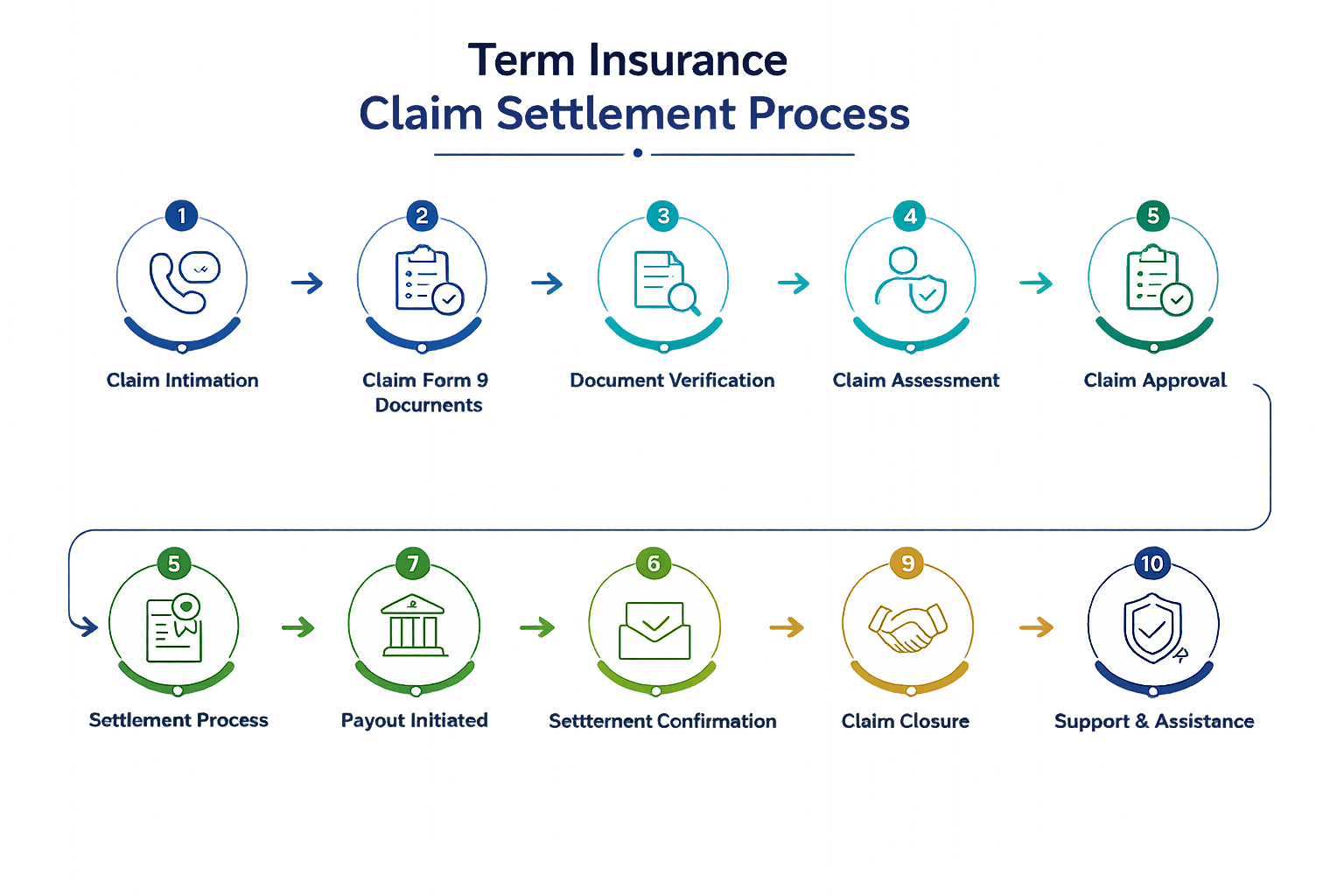
The nominee should not wait for the original policy bond before informing the insurer. Intimation starts the process, and the insurer can explain alternatives when the bond is lost. Delayed claims are not automatically invalid, but unexplained delay can complicate verification. Intimate promptly and document the reason for any unavoidable delay.
Most delays ek “big legal problem” se nahi, scattered documents se hote hain. Pooja ke husband ki death hospital mein hui, par discharge summary, last consultation, death certificate aur claim form mein disease dates different the. Insurer clarification maangega. Nominee ko ek chronological file banana chahiye: diagnosis date, admission, treatment, death, police record—sab same timeline mein.
| Claim type | Core documents | Additional records |
|---|---|---|
| Natural death at home | Claim form, death certificate, nominee KYC, bank proof | Treating-doctor certificate and medical history if requested |
| Hospital death | Core set | Admission notes, discharge/death summary, investigations, treatment papers |
| Accidental death | Core set | FIR, inquest, post-mortem, final police report, driving licence where relevant |
| Suicide or suspicious death | Core set | Police and forensic records, policy commencement/revival details |
| Death abroad | Core set | Foreign death certificate, passport, consular or authenticated records, travel details |
| Early claim | Core set | Proposal, medical records, income and prior-insurance verification may be examined closely |
Provide legible copies in the format requested and never alter medical papers. If names differ across Aadhaar, bank and policy, prepare supporting identity or legal documents. A nominee is a recipient under the policy framework, but succession questions can arise depending on nomination category, assignment, will and personal law.
Life claims are expected to be processed promptly. The regulatory framework requires the insurer to seek necessary information and decide after receipt of complete papers within the prescribed turnaround time. A claim may require investigation when facts, timing or documents warrant verification. Investigation is not itself rejection; it is a process to test the contract and event.
Claims in the early years, recent revivals, very high cover, conflicting medical information, unnatural death or mismatched income can receive deeper review. The family should cooperate, but it can ask for requests in writing and challenge repeated or irrelevant requirements through grievance channels. Where payment is delayed beyond the applicable timeline, regulatory interest provisions may apply.
Har document ke upar claim number likho, scanned PDF ka clear naam rakho—“01 Death Certificate”, “02 Nominee PAN”, “03 Hospital Summary”—aur submission acknowledgement save karo. WhatsApp photo bhejna easy hai, lekin organised email trail dispute ke time zyada useful hota hai.

Comprehensive explanations and guide from coverage to benefits to claim to premium.

Evaluate current term options, underwriting, payout choices and claim considerations.
Section 45 is one of the strongest policyholder protections in Indian life insurance. A life policy cannot be called into question on any ground after three years from the latest relevant date specified by the law, which can include issuance, commencement of risk, revival or addition of a rider. Within the permitted period, the insurer may question the policy on fraud or material misstatement according to statutory conditions and must communicate grounds in writing.
The rule is frequently oversimplified as “every claim after three years must be paid.” Premium status and contract scope still matter. A policy that lapsed before death does not become active because three years passed. A critical-illness rider does not pay for a disease outside its definition. Section 45 limits challenge to the life policy on misstatement grounds; it does not rewrite every benefit or remove every contractual requirement.
Emotional arguments are weaker than documentary contradictions. A strong representation links each allegation to the proposal question, medical record, date and policy clause. Do not sign a full-and-final settlement without understanding its effect.
Nomination tells the insurer whom to pay under the policy process. It does not solve every succession question. The legal position can depend on the nominee’s relationship, the Insurance Act, assignment, a will and personal succession law. Spouse, parents and children may receive beneficial-nominee treatment under applicable provisions, but complex families should not rely on a form field as an estate plan.
Assignment transfers rights in the policy and can override nomination. Loan-linked assignments should be checked after repayment. Keep nominee name, relationship, date of birth, contact and bank details current. For a minor nominee, appoint an appointee as required.
A married man may structure an eligible life policy under Section 6 of the Married Women’s Property Act for the benefit of wife, children or both. The policy creates a protected beneficial arrangement and can keep proceeds separate from the policyholder’s estate and certain creditor claims, subject to law and facts. The decision is difficult to reverse, beneficiaries are fixed within the permitted structure and professional advice is sensible for business owners or complex estates.
Vikram business owner hai aur personal guarantees bhi diye hain. Normal nomination aur MWP structure legally same nahi. MWP election proposal ke time carefully karna hota hai; baad mein casually beneficiary change nahi kar sakte. Yeh powerful protection tool hai, checkbox nahi.
Never cancel an old policy before the new policy is issued and risk has commenced. An application, premium payment or medical test is not proof of cover. Maintain overlap until replacement is confirmed, then evaluate whether retaining both policies is useful.
Life insurance does not have health-insurance-style portability. To change insurer, you apply for a new policy with fresh age, health and financial underwriting. The new insurer can load, restrict or decline. The old policy’s age-based pricing and contestability history do not transfer.
A switch should therefore solve a real problem: inadequate cover, unsuitable term, poor payout structure or service concern. Saving a small premium may not justify restarting underwriting at an older age. Keep the old plan until the new policy document is received and audited.
Eligible life insurance premium can be included within the combined ₹1.5 lakh ceiling under Sections 80C, 80CCC and 80CCD(1), subject to statutory premium-to-sum-assured conditions. The practical limitation is tax-regime choice. The new tax regime is the default for AY 2026–27 and most Chapter VI-A deductions, including Section 80C, are not available there. A buyer should not purchase term insurance merely to create a deduction that may not apply.
Death proceeds are generally exempt under Section 10(10D), and the tax law protects death benefits even where certain premium conditions affect maturity exemptions. Keyman insurance and unusual ownership structures need separate advice.
A major 2026 change is indirect tax. GST on qualifying individual life insurance policies was reduced to zero from 22 September 2025. This applies to individual term policies and other qualifying individual life contracts. Group term and group credit-life policies remain outside that individual-policy exemption and can continue to attract 18% GST. Verify invoice classification, especially for employer and loan-linked arrangements.
| Tax point | 2026 position | Practical meaning |
|---|---|---|
| Section 80C premium | Within combined ₹1.5 lakh limit, subject to conditions | Generally useful under old tax regime |
| New tax regime | Most Chapter VI-A deductions unavailable | Do not count 80C benefit without checking regime |
| Death benefit | Generally exempt under Section 10(10D) | Keep settlement and policy records |
| Individual life-policy GST | 0% from 22 September 2025 | Individual premium invoice should reflect exemption |
| Group life GST | Separate treatment; commonly 18% | Employer and credit-life cover is not the same category |
Salaried applicants usually have straightforward income proof through salary slips, Form 16, bank credits and filed returns. The common mistake is treating employer group cover as permanent. Job changes, layoffs, retirement and policy redesign can remove it. Personal cover should be calculated without depending heavily on employer benefits.
Salary growth should trigger a cover review. A policy bought at age 24 for ₹50 lakh may be inadequate after marriage, a home loan and a salary three times higher. Buying an additional policy can preserve the low-cost old cover and add current protection.
Financial underwriting is often harder than medical underwriting for entrepreneurs. Insurers assess sustainable income, business continuity, ownership, debt and existing cover. Low declared taxable income can cap eligibility even when business turnover is large. Clean ITRs, audited statements, bank records and a consistent application improve the case.
Separate family protection from business protection. Personal term cover replaces household income. Key-person or partnership arrangements protect business economics and require separate structuring. Personal cover should not be assigned casually to a lender when the family is the intended beneficiary.
A homemaker contributes replacement-cost value and enables the earning spouse to work. Childcare, domestic management and elder care can require substantial capital after death. Insurers may offer spouse cover based on household income, the earning spouse’s cover and product rules.
Compare two individual policies with joint-life structures. Individual contracts provide independent nomination, cover and continuity. A joint plan may be convenient but can have complicated first-death and survivor rules.
Women may receive favourable mortality pricing and special discounts, but adequate cover is more important than the discount. Working women should insure their full contribution to household goals, not only debt. Career breaks, maternity history and income changes should be presented accurately.
Single mothers, women supporting parents and women business owners often remain underinsured because calculators assume a traditional household. The cover formula must reflect dependants, unpaid care and business obligations.
Many Indian insurers accept overseas residents, but eligibility varies by country, visa status, occupation and travel. The proposal asks residence history, expected stay, foreign address, tax residency and medical information. Some countries or occupations can produce loading or limits.
Medical tests may be completed in India or through approved overseas centres. Clarify who pays, whether reimbursement has a cap and how reports must be authenticated. Premium can be paid through permitted banking channels. The nominee should know whether claim papers need notarisation, apostille or consular verification.
Arjun UK mein rehta hai aur policy India ki hai. Usne spouse ko sirf policy number diya. Better file mein passport copy, overseas address, premium account, nominee KYC, insurer NRI helpline aur foreign-death-document list bhi honi chahiye. Worldwide cover tab useful hai jab paperwork ka route family ko pata ho.
A lender’s group credit-life plan and a personal term plan solve overlapping but different problems. Credit-life cover may reduce with loan balance and pay the lender. Personal term cover can clear the loan and still provide income replacement. The family’s need does not fall merely because the loan falls; education and household expenses continue.
| Feature | Personal term plan | Group credit-life plan |
|---|---|---|
| Beneficiary control | Nominee receives according to policy structure | Lender often has primary interest |
| Cover pattern | Usually level or chosen increase | Often linked to reducing loan |
| Portability | Independent of lender | Linked to loan and master policy |
| Underwriting | Individual assessment | Can be simplified |
| Use after loan closure | Continues through selected term | May end with loan |
Diagnosis does not automatically mean rejection. Underwriters examine control, duration, medication, complications, laboratory results, age and other risks. Well-controlled hypertension with regular follow-up may receive better terms than undiagnosed or poorly managed disease.
Do not stop medicine before tests or attempt to manipulate results. Disclose the first diagnosis, medication and physician details. Submit recent reports if allowed. If one insurer postpones or loads, compare another insurer only with identical disclosure and disclose the previous decision when asked.
Two or three policies can provide flexibility. One may cover the long-term income need, another the home-loan period and a third later income growth. Multiple insurers also diversify service dependence, though contractual claim risk is not eliminated by splitting.
The disadvantages are administration, multiple premium dates and multiple claim files. Disclose every policy and pending proposal. Total cover must remain financially justifiable. Create a one-page register with policy number, insurer, cover, term, premium date, nominee and claim contact.
Family ko “mere paas 3 policies hain” bolna enough nahi. Google Drive ya physical folder mein one-page summary rakho. Death ke baad nominee ko insurer discover karne mein months nahi lagne chahiye.
Employer cover is valuable and usually inexpensive to the employee, but it is not owned in the same way as a personal contract. The employer is master policyholder, benefits can change annually and cover can cease with employment. Conversion or continuation facilities, if any, are product-specific.
Personal term cover should be sized around family need and retained across jobs. Employer cover can reduce the immediate gap but should not be the foundation of a thirty-year protection plan.
Pradhan Mantri Jeevan Jyoti Bima Yojana provides low-cost renewable life cover under scheme rules. It is valuable social protection but the benefit is much smaller than the capital required by most earning households. It should supplement, not replace, a properly calculated retail term plan.
| Point | PMJJBY | Retail term insurance |
|---|---|---|
| Purpose | Basic mass-market protection | Customised long-term income replacement |
| Cover amount | Scheme-defined and limited | Based on underwriting and need |
| Renewal | Annual scheme participation | Long policy term with chosen payment structure |
| Underwriting | Simplified scheme conditions | Detailed individual underwriting possible |
Premium is visible; institutional quality is not. Compare multiple dimensions and use the latest annual figures on a consistent basis. Claim settlement ratio by number shows what percentage of claims were paid, but a high ratio does not prove that every claim is valid or that service is fast. Amount settlement ratio shows value paid, which can differ because of high-ticket cases. Solvency indicates capital adequacy, not customer service. Complaint data provides context but can be influenced by company size and product mix.
A high claim-settlement ratio is useful context, not a personal guarantee. Read it alongside claim amount ratio, solvency, complaint handling, product wording, underwriting discipline and servicing quality. A company can report an excellent ratio and still dispute an individual claim when the proposal contains a material omission.
| Metric | What it tells you | What it cannot tell you alone |
|---|---|---|
| Individual death claims paid ratio | Share of claim count paid in the year | Quality of disclosure or future claim outcome |
| Amount settlement ratio | Share of claimed value paid | Reason for a few large disputed claims |
| Solvency ratio | Capital buffer against regulatory requirement | Speed and fairness of claim service |
| Complaint volume | Service-friction signal | Meaning without adjusting for customer base |
| Persistency | How many customers continue policies | Whether continuation was economically optimal |
| Product wording | Actual contractual benefit and restrictions | Operational service quality |
Use annual audited or regulator-published data and avoid ranking claims based on one quarter or combining group and individual ratios. The strongest shortlist balances contract quality, service accessibility, financial strength and a premium you can sustain.
A “best plan” depends on the buyer’s objective. A young parent may prioritise low-cost level cover and life-stage increase. A business owner may prioritise high financial underwriting capacity and MWP structuring. A diabetic applicant may value a fair medical offer over the cheapest standard-rate quote. An NRI may prioritise overseas medical and claim support.
Start with the insurer’s customer service and grievance redressal officer. State policy number, issue, chronology, requested remedy and supporting records. Obtain written acknowledgement. Insurance grievances should be resolved within the prescribed service timeframe.
If the insurer does not resolve the complaint or the response is unsatisfactory, use IRDAI’s Bima Bharosa platform. Policyholders can also contact the IRDAI grievance call centre. Eligible disputes can be taken to the Insurance Ombudsman, including delay, repudiation, premium disputes, misrepresentation and policy servicing. The Ombudsman can mediate and issue an award under the governing rules.
A good term policy is usually boring after purchase. The premium leaves on time, the nomination stays current, the family knows where the documents are, and the cover quietly sits behind the household balance sheet. That is success.
The policy becomes dangerous when the buying process is rushed: an income figure is exaggerated to qualify for more cover, tobacco is omitted because it was “only occasional”, a rider is selected without reading its trigger, or the premium is stretched so far that the plan lapses during a difficult year. These are preventable failures.
Before paying, print the final proposal PDF. Check every answer. Recalculate the protection gap. Show the payout choice to the nominee. Then compare the policy wording—not merely the premium—with at least two alternatives. Buy only when all five pieces agree: adequate cover, truthful disclosure, sustainable premium, understandable benefits and a claim file the family can actually use.
Educational estimate before insurer underwriting

Complete saving plan guide: coverage, plans, benefits and inclustion.

Evaluate current term options, underwriting, payout choices and claim considerations.
Prevent disclosure errors and prepare a defensible nominee claim file.